J. Edgar Review
Posted by Jeremy Wilson on 11.12.2011
Leonardo DiCaprio gives a powerful performance as J. Edgar Hoover, the famed FBI leader, but can the rest of the film match it? 411's Jeremy Wilson checks in with his full review!
Directed by: Clint Eastwood Written by: Dustin Lance Black
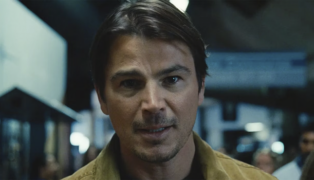
J. Edgar Hoover: Leonardo DiCaprio Clyde Tolson: Armie Hammer Helen Gandy: Naomi Watts Bruno Hauptmann: Damon Herriman Robert F. Kennedy: Jeffrey Donovan Anna Marie Hoover: Judi Dench Charles Lindbergh: Josh Lucas Harlan F. Stone: Ken Howard Arthur Koehler: Stephen Root Alexander Mitchell Palmer: Geoff Pierson Lela Rogers: Lea Thompson Young J. Edgar: Jack Burns
Rated R for brief strong language. Running Time: 137 minutes
I have enormous respect for Clint Eastwood as a director. He is by no means perfect, but films like Unforgiven, Million Dollar Baby, Letters From Iwo Jima and Gran Torino all deserve high praise and to be recognized as great films of the last 20 years. Eastwood in many respects is one of the last remaining members of Hollywood's Old Guard; his best movies feel like they could work and in any previous decade and era. That's a testament to him and his ability to craft a story and his ability to make you connect and care for characters (some of whom are a real challenge). However, Eastwood isn't the most creative of film-makers, and his worst films tend to feel skin-deep, full of platitudes and a nauseating sheen that makes them look better than they really are. Rarely however, does it feel like Eastwood completely fails one of his movies. Unfortunately, J. Edgar stands as perhaps his biggest failure as a director.
J. Edgar tells the story of J. Edgar Hoover (DiCaprio), the man responsible for creating and running the Federal Bureau of Investigation for nearly five decades until his death in 1972. The film attempts to give us the breadth of Hoover's life and career at the FBI: the Palmer Raids, the Lindbergh Baby kidnapping case, the JFK assassination, even including Hoover wiretapping notable figures including Eleanor Roosevelt and Martin Luther King Jr. In addition to his professional life, J. Edgar also showcases his relationship with his mother (Judi Dench) and his close personal...possible...lover/soul mate/partner, Clyde Tolson (Armie Hammer), who acted as his #2 man at the Bureau.
J. Edgar is not the worst movie you're likely to see this year (it is, after all, coming out the same weekend as Jack and Jill), but it may be something worse. For most of its 137 minute running time, the film is a jumbled, cold, nauseating bore. You see, J. Edgar has not one, but two fatal flaws, both of which doom it from the outset, never allowing its story, characters or themes a fighting chance. Ultimately, those fatal flaws – and the film's failure to live up to its pedigree and expectations – have to lie at the feet of Eastwood. If we're going to give him the credit for his masterpieces, he deserves the blame for his train-wrecks as well.
The first – and most glaring – of these flaws is the decision by Eastwood and Dustin Lance Black (Milk) to tell their story in a non-linear fashion. The film is constantly cutting back and forth, slipping through different time periods and back in such a way that it is nearly impossible to discern where we are exactly in history. The age makeup on the principal actors is one clue, but oftentimes the viewer has to wait a few minutes to pick up on whichever important historical event is going on at the time. The film's events are told by way of Hoover dictating the details of these events to biographers (there are a number of them).
Another problem is that Eastwood is attempting to make parallels between J. Edgar and modern-day events. However, he never takes a stand; J. Edgar tries to straddle the fence and plays it as safe as possible in the process. For the closest thing this country has ever had to an unchecked, unelected despot, it strains credulity that J. Edgar chooses to practically whitewash some of J. Edgar Hoover's more...let's just call them “unsavory” moments. Hoover is presented as a complicated man; simultaneously an unwavering patriot faced with forcing the country to see real dangers and as a paranoid tyrant prone to overreaching and overreacting. The problem is that when you cut back and forth as rapidly as Eastwood and Black do, the viewer can never get a handle of who J. Edgar Hoover is and what he's really all about (other than rooting out communism and dissension). The bombing of his predecessor's house is presented as a catalyst for his never-ending quest against communism, but it is intimated that he was like this before that bombing. The problem is that it only goes skin-deep; there is no evolution, no in-depth look at what made Hoover tick. “Commies and subversives are bad” is the repeated refrain, but why was this Hoover's continued focus for the vast majority of his career? Eastwood never really delves into why Hoover essentially ignored organized crime for the majority of his tenure. Not once is COINTELPRO mentioned. The extent of Hoover's involvement with the JFK assassination investigation is reduced to a phone call letting Bobby Kennedy know his brother had just been shot. This isn't minor, trivial stuff we are talking about; this is the stuff that has come to define J. Edgar Hoover as much as anything else. It would be like doing a huge biopic of Richard Nixon and skipping over Watergate.
Eastwood instead chooses to focus the majority of Hoover's professional career on his attempts to bring the Bureau into more modern times, arming officers and having science become the backbone of investigative work (including Hoover's attempts at bringing fingerprinting to the forefront of the Bureau's work, which is nearly beaten to death). The film uses the Lindbergh kidnapping as the framework for most of this, with a few supporting figures able to stand out in limited screen time (Stephen Root comes to mind as a quirky scientist specializing in wood patterns). The problem with these scenes is that they are simply not dramatic; cutting back and forth, interrupting the course of the investigation removes tension and forces the audience to try and keep pace with something we're not really that invested in -- Hoover's ongoing efforts to discover the whereabouts of the Lindbergh child and who kidnapped/murdered her. These scenes come off as filler, but might have been more effective had the middle part of the movie focused more on the case (in a more standard linear fashion). When not focused on the professional side of Hoover's life, J. Edgar actually hits its highest notes in showcasing the very complicated relationship between Hoover and Tolson.
It is a widespread (and somewhat justified) belief that Hoover was gay and that Tolson was as much a “partner” as he ever had. They were often seen together and when Hoover died, Tolson inherited his estate and moved into his home. It is hard to describe the exact nature of the relationship between Hoover and Tolson, because the film doesn't go out of its way to define it or cast judgment. It does strongly intimate a bond between the two that went beyond mere friendship, but there is certainly room left to wonder whether they ever engaged in physical intimacy. This aspect of the film is well done; their relationship strikes true and viewers can easily imagine the inner torment (and parental pressures) a public official such as Hoover could face in an age where homosexuality was not yet accepted. There is one scene in particular, where emotions and tensions boil over that – while being a bit melodramatic – is effective in showing the effects of the era's moral standards and judgments on individuals who may have been bisexual or homosexual.
The problem, however, is that while the authenticity of that complex relationship feels genuine, the love and affection that Tolson (and to a lesser extent Helen Gandy) has for Hoover is hard to understand and Eastwood doesn't even try to provide any insight. Hoover by all accounts – even in what is present in J. Edgar – is a strange, unsociable little man who has some serious demons and issues. Leonardo DiCaprio gives a weird, physical performance that is a bit unsettling at times, which is meant as a compliment. This is not an easy character to portray; Hoover spoke in a dialect very different from most and I thought DiCaprio did a good job of attempting to recreate it. In addition to a number of his scenes with Hammer, DiCaprio's work with Dame Judi Dench was an interesting – if frustratingly incomplete – look at a bizarre, yet strong, mother-son relationship. It is a good performance; I'm not entirely sure it is award-worthy, but there is little doubt DiCaprio will be nominated for an Oscar.
Finally, one of the aspects of J. Edgar that is getting the most attention is the makeup worn by DiCaprio, Hammer and Watts throughout much of the film. I actually thought DiCaprio's makeup was pretty decent, and he didn't seem inhibited by the constraints of wearing that much makeup. The same cannot be said for Armie Hammer as Tolson. I don't believe it is unfair or hyperbole to say that Hammer's makeup in J. Edgar is arguably the worst we have ever seen in a major Hollywood production. Unfortunately for Hammer, it is also obvious that he is incredibly uncomfortable in the makeup and it negatively affects his performance to a noticeable degree. The fact is that Hammer is made to look like a villain from Dick Tracy, aged about 200 years. Eastwood should have been looking out for his young actor; he never should have been put in a position that makes him look the fool, degrading the quality of his actual performance and the way the audience will perceive it. I think Armie Hammer is a talented actor with potential, but his work in J. Edgar is not a great start to a career as one of Hollywood's up-and-coming performers.
There are some interesting things in the story of J. Edgar Hoover and in J. Edgar. Unfortunately, Eastwood all too often doesn't go down the more interesting and dramatic side-streets and alleys in his own story. This is Oscar-bait, pure and simple. J. Edgar Hoover is one of 20th century America's most notorious and compelling figures, a man who served through eight Presidents and gathered enough illegal intelligence to sink countless numbers of well-known Americans. What Hoover may be known best for – those illegal files – is only touched upon and never judged. Hoover was the kind of man who did things that evoked strong reactions, one way or another. Instead of painting a strong, dramatic, coherent and compelling narrative on the man and his legacy, Eastwood and Black took the Cliffs Notes way out. J. Edgar is a Hollywood prestige film that fails to do anything beyond look decent and give its star a chance at major awards. It doesn't even scratch the surface of who J. Edgar Hoover was, what his motives and agendas were or the true impact of what his legacy meant for America then or now. Unfortunately, that failure falls at the feet of Clint Eastwood, as J. Edgar will go down as one of the greatest disappointments in his long and storied career.
The 411: J. Edgar is a severely flawed, overly long and frustratingly inconsistent movie. Leonardo DiCaprio gives a strong performance as Hoover, one of 20th century America's most iconic and infamous figures. However, the film is mediocre beyond that performance. Director Clint Eastwood has made great films in his long career, but his work here is poor, as is Dustin Lance Black's script. The film employs a non-linear format that causes the film to feel choppy, muddled and incoherent. Armie Hammer is drowned in some of the worst makeup we've ever seen in a major Hollywood prestige picture, and unfortunately, it negatively affects his performance and the film. Eastwood skates over or completely ignores some of the most important aspects of Hoover's story and work, ultimately leading to a film that ends up weak and distant. There are interesting avenues left unexplored and not even the authentic-feeling relationship between Hoover and Tolson can save it from being another sub-par period piece, intended more as Oscar-bait rather than being a true and searing exploration/examination of America's most important "top cop." I cannot imagine ever re-watching J. Edgar again, which is perhaps as strong and harsh a criticism as can be levied at a film. Not Recommended.
When the movie "reviewer" says he has a hard time following a non-linear story, his credit is torn down.
Posted By: Ant-LOX (Guest) on November 12, 2011 at 06:53 AM
I don't know about the movie but your review sure was comprehensive.
Don't know if I'll be seeing this one.
Posted By: Dennis Franz moustache (Guest) on November 12, 2011 at 08:17 AM
Better watch out. Itchy trigger finger Harry Callahan is at your door to do a cavity search with his 44.
Posted By: Bill Fn Murray (Guest) on November 12, 2011 at 09:25 AM
The guy playing Bobby Kennedy did an awful job. Show some respect for Bobby.
Posted By: RFK fan (Guest) on November 12, 2011 at 01:26 PM
Ant-LOX (Guest): To be clear: I don't have trouble following non-linear stories. Some of my all-time favorite films are non-linear in nature. That doesn't mean every single non-linear film is great. My problem is with how J. Edgar implements it. Some films' use of non-linear stories are stronger than others, and some are not necessary. This is one of the weaker ones.
Posted By: JeremyWilson (Registered) on November 12, 2011 at 03:59 PM
This movie is way better then this review is saying, the non-linear part is easy to follow. Only a moron wouldn't be able to follow it. It's also well done and helps show the relationship between clyde and Hoover. If Eastwood hadn't done it this way the movie would of been 30 minutes longer to show their relationship, instead he shows it with a couple quick camera shots of them being in their 30's then in their 70's. In my opinion it couldn't of been done any better. Clyde's make up was pretty bad considering Leo's was so good. This movie deserves an 8 at least. Highly recommended.
Posted By: Jonah (Guest) on November 14, 2011 at 10:02 AM
to Jonah: that is why you are not a film maker.
Posted By: Guest#3112 (Guest) on November 15, 2011 at 04:52 PM
Movie was OK, Leo was great as usual. Everything else... not so much. Felt brutally long, no flow, Hammer's makeup job was awful. I'd say a 6.
Posted By: Shah (Guest) on November 19, 2011 at 01:39 PM
I think the movie did a great job of being unbiased. While he was shown as a patriot, it was only through his own stories.
The movie could have used the color palettes better to distinguish the three "storylines". Present day, his story, and personal events that he wasn't telling. They changes in color were slight and should have been stronger.
The makeup alone should make this movie one of the worst of the year, but if u can look past that and the melodrama, it introduces people to one of the most controversial figures in American history.
Posted By: D (Guest) on November 20, 2011 at 11:55 AM
The movie was a mess. Leo's performance was the best thing about it, but everything else- meh. Hammer's makeup was embarrassing, and the non-linear nature, while I don't think it was hard to follow, ruined the narrative. Hoover had such a long career, it could have been better served by following a straight line.
Posted By: AndrewNiehaus (Guest) on December 06, 2011 at 08:32 AM
Copyright (c) 2011 411mania.com, LLC. All rights reserved.
Click here for our privacy policy. Please help us serve you better, fill out our survey.
Use of this site signifies your agreement to our terms of use.