3:10 to Yuma Review
Posted by Chad Webb on 09.10.2007
A solid remake that is saved by two marvelous leads.
Russell Crowe: Ben Wade
Christian Bale: Dan Evans
Logan Lerman: William Evans
Dallas Roberts: Grayson Butterfield
Ben Foster: Charlie Prince
Peter Fonda: Byron McElroy
Vinessa Shaw: Emmy Nelson
Alan Tudyk: Doc Potter
Luce Rains: Marshal Weathers
Gretchen Mol: Alice Evans
Lennie Loftin: Glen Hollander
Directed By: James Mangold
Release Date: September 7, 2007
Running Time: 2 hours
Rated R for violence and some language.
These days, the Western genre occupies a small space in the catalogue of yearly releases. Audiences can usually expect one or two, but not much more than that. Studios are afraid that unless a Western is packed with shootouts, blood, and plenty of action, viewers will ignore it. 3:10 to Yuma represents a scoff at that fear. It possesses a fair share of gun slinging and carriage chases, but that is secondary to the themes presented in the story. The first offering of its kind in 2007 is a commendable one, but 2008 is several months away, and this is not perfect, so who knows if this will stand as the best cowboy yarn of the year.
3:10 to Yuma is a remake of the 1957 Delmer Daves original starring Van Heflin and Glenn Ford. That 50-year-old-film, based on an Elmore Leonard short story, was unjustly criticized because of its similarities to High Noon. Both followed the technique of instilling suspense with the steady “by the clock” method, but I enjoyed Yuma more than High Noon. The characters motivations, manners, and history made more sense, and the ending was superior. Director James Mangold (Walk the Line) updates this classic with a faithful stroke, but newfound panache, and the modifications made by screenwriters Halsted Welles, Michael Brandt, and Derek Haas were appropriate, but minor.
Ben Wade (Russell Crowe) is a notorious robber, who has ambushed 22 stagecoaches. Dan Evans (Christian Bale) is a poor rancher, whose land is being threatened by Glen Hollander (Lennie Loftin). When Dan’s cattle break loose, he and his sons ride out to gather them back. Their paths cross with Ben Wade when they stumble upon the wanted criminal robbing a loaded stagecoach filled with money and guarded by Byron McElroy (Peter Fonda). When Wade leaves with the loot, he heads for the town of Bisby. After his gang sends the Marshall and his deputies out on a bogus hunt, the boys relax at the bar. Shortly thereafter, Evans spots Wade in town, and keeps him talking until the Marshall returns and arrests him. The plan is to transport Wade to the train traveling for Yuma prison at 3:10. A group is assembled for the journey to the nearest station in Contention. Dan volunteers as long as he receives a vital $200 pay. The trip is increasingly difficult with Wade’s gang in hot pursuit, Apache Indians hiding in the hills, and the concern of Dan’s own son William (Logan Lerman) refusing to stay home. As time goes by, Dan realizes he must finish his job, and make sure Wade gets on that train.
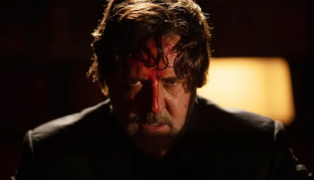
The hardest performance was given to Russell Crowe as Ben Wade. He had to fill the shoes of Western legend Glenn Ford (Fastest Gun Alive). Crowe was the ideal choice for this role, as only he could convey the charm and mercilessness of Wade as brilliantly as Ford. It is the cocky sneer in Crowe’s eye that is alluring. Wade is built as a villain, but also a type of hero. He is cold-hearted, but human, and his calmly roguish demeanor attracts a Bisby bartender, among others. At times, Crowe lands a little too close to Ford’s work, but it is the execution of Wade’s mind games on Evans that will garner approval and praise. Crowe is a fabulous actor, who deserves credit for blending the character with his own talent and the known traits of the Ford depiction.
Dan Evans is a Civil War veteran, who lost a leg, and is now trying to raise a family. Christian Bale has proven to me that there is very little he can not accomplish when he puts his mind to the mission. Bale looks nothing like Van Heflin, the man who formerly portrayed Evans, but Bale generates that same discomfort and that same stubborn pride beautifully. The key is how Wade’s psychological manipulation agitates Dan. Take the scene where Wade is discussing Dodge City with his son, William Evans. The irreplaceable fury in Bale’s face is worth the price of admission alone. Bale achieves a near impossible task. He is better than Van Heflin because he adds another hauntingly passionate layer to Dan’s façade.
Ben Foster is outstanding as the wickedly evil Charlie Prince, Wade’s second in command. Foster has gained a lot of attention lately, with tremendous contributions to Alpha Dog and the below average Hostage. Foster is easy to despise, and his bloodthirsty tendencies will result in scathing reactions from moviegoers. Peter Fonda and Gretchen Mol lend some exceptional supporting performances as Bryon McElroy, a bounty hunter with a personal vendetta against Wade, and Dan’s worried wife, Alice Evans. They help boost the weights carried by Crowe and Bale.
Many referred to Cop Land, the 1997 sophomoric film from Director James Mangold, as an urban western. I happen to agree, and his intelligence in shaping and crafting a disciplined tale with deliberately paced gun battles has remained sharp a decade later. Mangold has kept the imperative sub-plots and crucial moments, yet elected not film this as a shot-for-shot recreation, which was a wise choice. The insertion of William Evans as an assistant in this trek was terrific. This further exposes and reveals Dan’s need to replant the support from his wife and children that has dissipated. William marks the primary change from both versions, but it is welcomed as a thought provoking twist.
The beginning robbery of the Pinkerton stagecoach is an invigorating sequence with Gatling guns, and a horrendous crash, but towards the middle of the film, the quietly spoken lines start to slag on the viewer, but not in excess, or to the point of ruining the experience. What is missing that I adored from the original is that claustrophobic feeling as the two men are trapped in the hotel room, staring and listening to each other as the clock ticks closer to their fates. Nonetheless, Bale and Crowe exchange dialogue so naturally, and with such gusto that their abilities surpass any petty complaints. The concluding sprint to the station finally introduced an excellent score from Marco Beltrami, and combined with Phedon Papamichael's granular cinematography, it was a first-rate finale.
Admittedly, I was most concerned with how the ending would unfold. Luckily, it was altered with respect for the original, and even though it does not outshine the 1957 finish, it is definitely satisfying and poignant. Do not dwell on the action-oriented trailer. 3:10 to Yuma is a dramatic western. It is a study of personalities and emotions; how an outlaw and rancher can admire one another. It is a morality play on doing what is just. Regardless of some preventable stretching, Mangold has constructed an engaging and fervent contemporary fable that should thrill the masses.
The 411: Without the star power of Russell Crowe and Christian Bale, the 3:10 to Yuma remake would be met with a slightly different response, but no matter. The two actors, along with superb filmmaker James Mangold have completed and delivered an entertaining Western that is not spotless, but good enough to recommend. I hope for two things. 1) This will urge more to seek out the better original, and 2) audiences will pay to see this, thus convincing studios that the Western is not dead, and needs to have a more substantial place with regular theatrical releases.